

Thursday 13 March 2025
The quest for a deeper understanding of the mathematical underpinnings of geometry has led researchers down a complex and winding path. Recently, a team of mathematicians made significant headway in this endeavor by establishing a new connection between the properties of hyperbolic groups and their ability to embed in finite products of quasitrees.
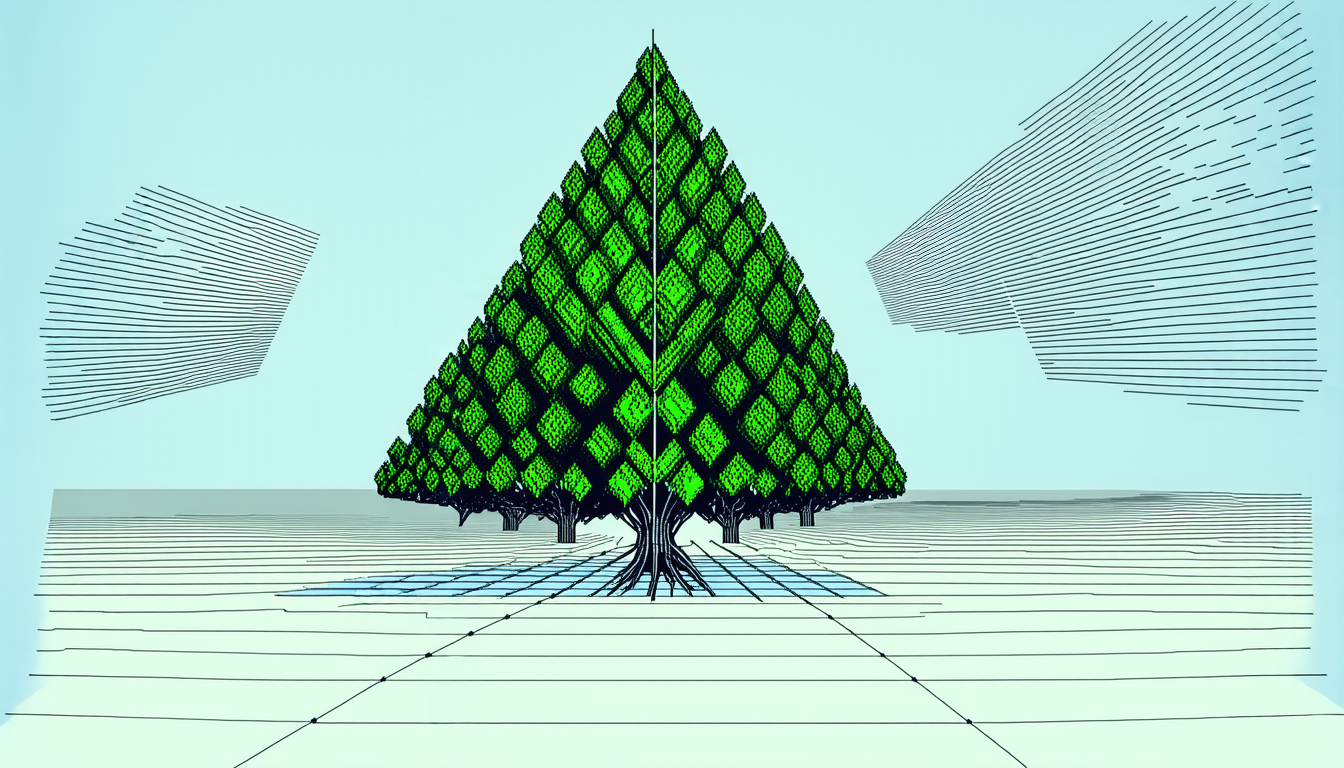
At its core, the research explores the relationship between two seemingly disparate concepts: hyperbolic geometry and quasitrees. Hyperbolic geometry is a branch of mathematics that studies spaces with negative curvature, where parallel lines converge at infinity. Quasitrees, on the other hand, are geometric structures built from trees, which are networks of connected nodes.
The connection between these two areas lies in the properties of hyperbolic groups, a type of mathematical object that can be thought of as a group acting on a hyperbolic space. Researchers have long known that certain types of hyperbolic groups admit proper actions on finite products of quasitrees, but the precise conditions under which this is possible had remained unclear.
The breakthrough came when mathematicians discovered that the properties of hyperbolic groups are closely tied to their ability to embed in finite products of quasitrees. Specifically, they found that if a hyperbolic group has strong (QT), or quasi-isometric type, then it can be embedded in a finite product of quasitrees.
This finding has far-reaching implications for our understanding of geometric structures and the properties of hyperbolic groups. It also opens up new avenues for research into the geometry of hyperbolic spaces and the behavior of hyperbolic groups under various transformations.
One of the most significant consequences of this discovery is its application to the study of mapping class groups, which are fundamental objects in topology and geometry. Mapping class groups describe the symmetries of surfaces, such as the ability to stretch, shrink, or bend a sphere without tearing it apart. By applying the new connection between hyperbolic groups and quasitrees to mapping class groups, researchers can gain deeper insights into their properties and behavior.
The research also has implications for our understanding of the asymptotic dimension of geometric structures, which describes how well they approximate infinite-dimensional spaces. The finding shows that certain types of hyperbolic groups have a finite asymptotic dimension, which in turn allows for more precise estimates of the distance between points on these structures.
Cite this article: “Unveiling the Geometry of Hyperbolic Groups and Quasitrees”, The Science Archive, 2025.
Geometry, Hyperbolic Groups, Quasitrees, Finite Products, Mathematical Objects, Group Theory, Geometric Structures, Topology, Mapping Class Groups, Asymptotic Dimension





