
Tuesday 25 March 2025
A recent study has shed new light on a fascinating topic in graph theory: Hamiltonian cycles. These are paths that visit every vertex of a graph exactly once before returning to the starting point. In this case, researchers focused on signed and multisigned complete graphs, which have both positive and negative edges.
The study’s findings have significant implications for our understanding of these complex mathematical structures. For instance, it was discovered that in signed complete graphs with an odd number of vertices, all Hamiltonian cycles are either entirely positive or entirely negative. This means that if you find a Hamiltonian cycle with some negative edges, the entire cycle must be negative.
The researchers also found that in multisigned complete graphs, where each edge has a label from a set of possible signs, there is a direct connection between the signs of the triangles and the signs of the Hamiltonian cycles. Specifically, if you have two Hamiltonian cycles with different signs, it’s guaranteed that the graph contains at least two triangles with different signs.
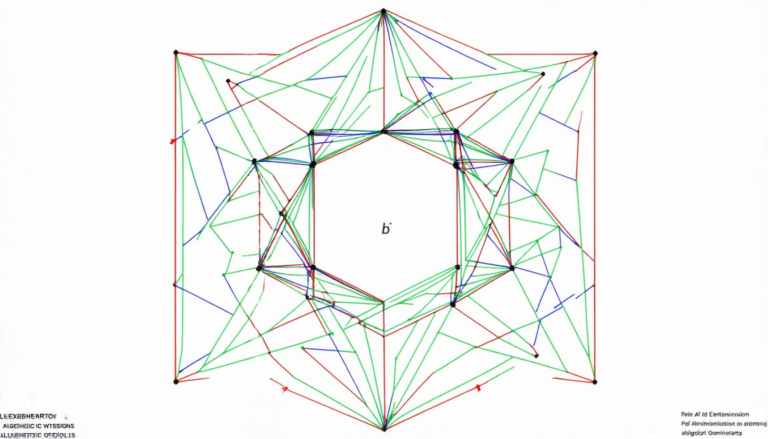
These discoveries were made possible by the Hourglass Lemma, which states that two Hamiltonian cycles in a multisigned complete graph are equivalent if certain specific conditions are met. This lemma was used to prove other important results, such as the Consistent Triangle Multisign Lemma and the Hourglass Shape used in the proof of the Hourglass Lemma.
The study also explored the relationship between the signs of triangles and Hamiltonian cycles in signed complete graphs. It turned out that if all Hamiltonian cycles are negative, it’s because all triangles are negative and the number of vertices is odd. On the other hand, if all Hamiltonian cycles are positive, it could be because all triangles are negative and the number of vertices is even, or all triangles are positive.
One of the most intriguing findings was that a signed complete graph contains both positive and negative Hamiltonian cycles only if it contains at least one positive triangle and at least one negative triangle. This has implications for our understanding of these complex structures and how they can be used to model real-world systems.
The researchers behind this study are experts in graph theory, and their work has the potential to open up new avenues of research in this field. Their findings could have applications in fields such as computer science, engineering, and mathematics, where complex networks and graphs are a crucial part of many problems.
Overall, this study is an important contribution to our understanding of Hamiltonian cycles in signed and multisigned complete graphs.
Cite this article: “Unraveling the Secrets of Signed and Multisigned Complete Graphs”, The Science Archive, 2025.
Graph Theory, Hamiltonian Cycles, Signed Graphs, Multisigned Graphs, Complete Graphs, Triangle Signs, Cycle Signs, Hourglass Lemma, Consistent Triangle Multisign Lemma, Graph Structure
Reference: Xiyong Yan, “Hamiltonian Cycles in Signed and Multisigned Complete Graphs” (2025).